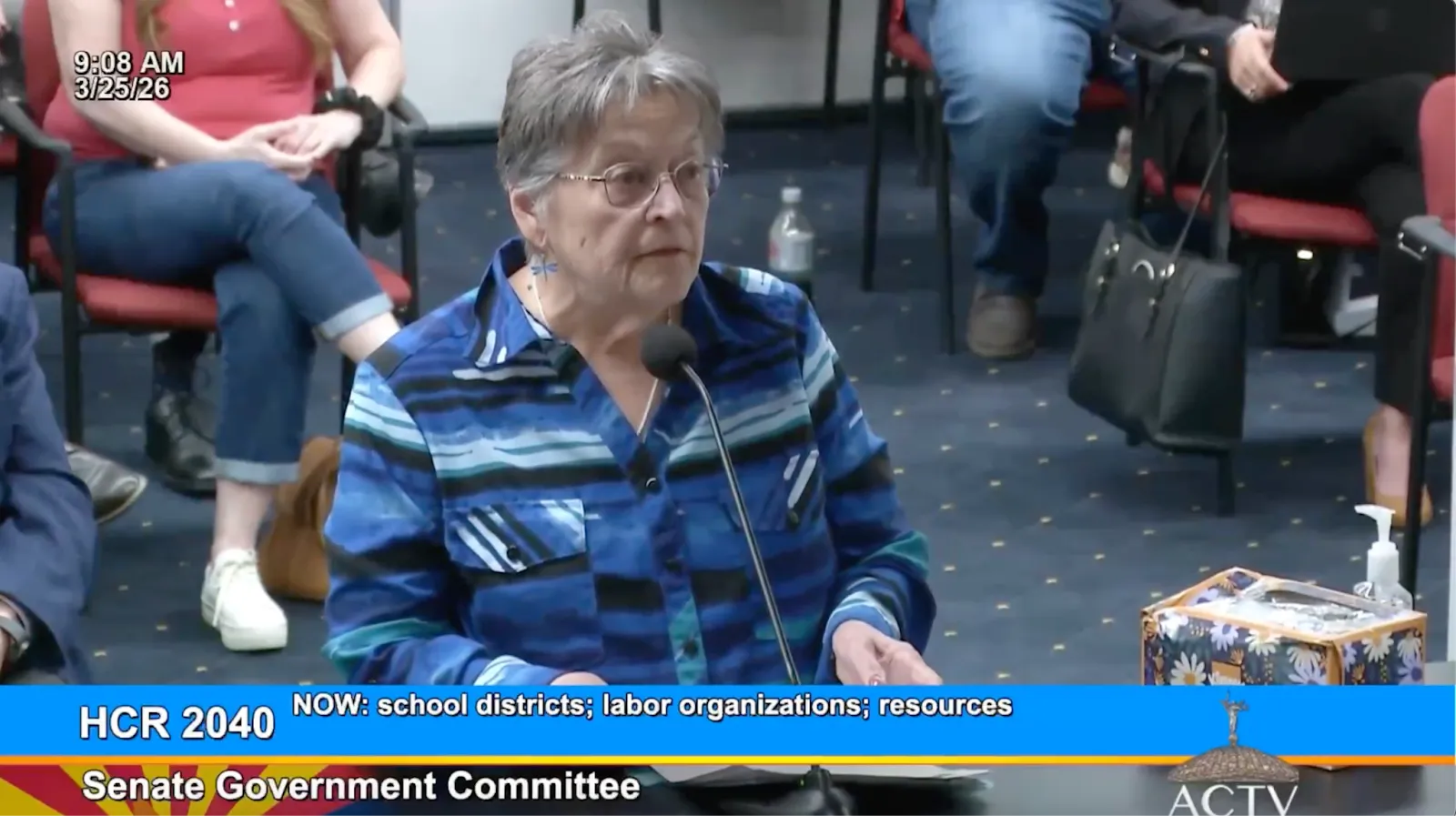
PHOENIX — Today, retired Arizona union educators joined labor and community partners to testify against HCR 2040 — a destructive and partisan ballot referral that would restrict how Arizona educators can advocate for better learning conditions for their students. The Senate Government hearing began at 7:00 a.m., and HCR 2040 was not heard until more than two hours later, making it impossible for working educators to testify in defense of their own right to join a union and advocate for their schools.
AEA President Marisol Garcia’s previous statement on HCR 2040 can be found here.
“Arizona is a right-to-work state in a nation that cherishes freedom of choice. Arizona nurses, firefighters, and educators are free to join unions, and we are free to choose not to join unions. That freedom should not be hindered in any way,” testified Dr. Janie Hydrick, a lifelong educator who served as President of the National Council of Teachers of English and on the Board of the National Board for Professional Teaching Standards. “HCR 2040 singles out payroll deduction for union membership, while keeping it for taxes, retirement contributions, and insurance. Our union dues give us a collaborative voice in professional development, learning conditions, class sizes, curriculum, pedagogy, and affordable health care. My trail of excellent teaching is thousands of students long and includes doctors, architects, engineers, and a sprinkle of politicians. I could not have accomplished all that — and in fact, would have left the teaching profession soon after entering — if I had not had a strong voice through my union.”
“When I graduated in 1971 and started my career, I realized that my voice alone did not matter in my school or in my district. It was only through a union that my voice could be heard,” testified Linda Somo, a retired teacher and counselor who spent 30 years in Mesa Public Schools. “Since I've been able to compare different districts, I found that districts that have a strong association with a union are much better, not only for the teachers, but for the students and for the families that they serve, because they're able to cooperate in solving problems. How ridiculous to say that an individual teacher could negotiate things directly with the school board. They're not going to listen to a single voice. They're only going to listen to us if we have our union. If you take away the rights of someone who has worked for 20 years and then is involved in a strike and they lose their pension, that's criminal. You cannot do that, and you should not do that. This bill should get a no vote from everyone on this committee.”
“I have a degree in secondary education, but I didn't learn how to teach at ASU,” testified Steve Ramos, who taught in Mesa Public Schools for three decades. “I was given a student teaching assignment with a teacher and a union member at Mesa High School — that's where I learned to teach. After graduation, I was hired by Mesa High School to teach for the next 32 years. I continued learning from teachers and union members at Mesa High. I have both attended and taught professional development classes offered by my union. My salary and working conditions were shaped by negotiations between the district and my union. Educators have a right to instruct districts to have their union dues, investment contributions, charity contributions, and other items taken out of their paycheck. I ask for a no vote on HCR 2040.”
If passed by the legislature and approved by voters, HCR 2040 would:
- Nullify existing agreements between school districts and educators that protect smaller class sizes, preserve lesson planning time, protect stable wages and benefits, and prevent educator attrition and burnout.
- Prevent educators and administrators from meeting during school hours to discuss issues that affect student learning.
- Restrict how educators can communicate with each other about safety hazards and other issues that affect students.
- Ban education unions from using payroll deductions to collect voluntary dues. Payroll deductions are voluntary contributions that employees choose to have taken directly from their paychecks. Arizona currently allows more than two dozen types of payroll deductions for state employees, including deductions for private insurers and private debts. Under HCR 2040, unions representing police officers, firefighters, and other public employees could continue using payroll deduction to collect dues, but education unions would be singled out and banned from the payroll deduction system. Educators’ union dues help fund the largest professional development program in the state, along with other key supports for teachers and students. The AEA maintains a separate political action committee for political engagement, and member dues are not used for contributions to candidates. Public money does not pay union dues.
- Revoke basic employment rights and other benefits, including state pensions, from teachers who participate in a strike or organized work stoppage. This provision is written so broadly that it could ensnare educators who speak to each other about illnesses and other legitimate absences from work.